
Human Performance under Pressure
The hum hit you first. Computers, fans spinning, air-conditioning straining. The whine of a centrifuge. The chatter of marmosets. Children’s laughter drifting from the play labs.
This was the Biomathematics Department at the Institute of Psychology, University of Zurich, in the 90s. State of the art, but still hands-on, much of the equipment built by hand.
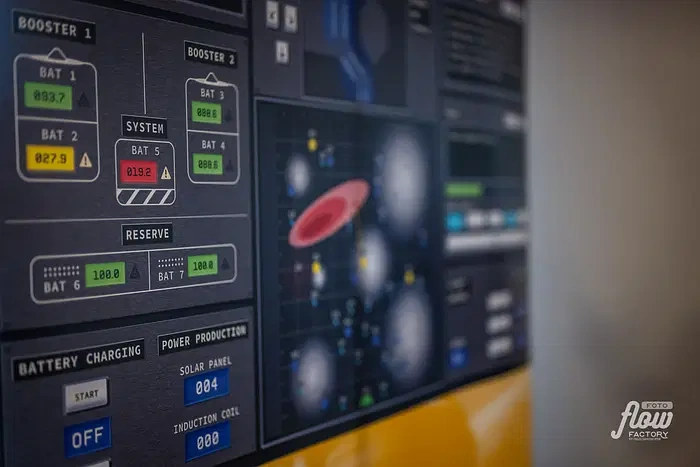
At its centre stood the capsule. A spaceflight simulator on a motion platform. Not sleek or commercial, but a frontier. My colleague and I had spent months programming the flights in Fortran until finally we were ready.
That afternoon, a participant strapped in. The door closed, the screens lit, and the hum fell away. At first, they flew with ease, curious, confident, playful – the mothership always close by. Then came the twist: the mothership began to drift. Slowly. Relentlessly. Until it was only a speck.
That was the breaking point. Shoulders locked. Breath quickened. Hands flying over the controls, firing wildly on any appearing object, while the defensive shield rendered every shot useless. The harder they fought, the worse it became. Within minutes, performance flatlined.
When the capsule opened, they stepped out pale, shaken. But the real insight came in the debriefing. Step by step, they retraced the moment panic took hold, saw how stress narrowed their choices, how they had trapped themselves in a loop.
That conversation mattered as much as the flight itself. The simulator exposed behaviour. The debrief gave it meaning, turning fear into awareness, failure into learning and eventually resilience.
And for me, it was unforgettable. Proof that when you immerse people in situations where the outcome is not scripted, where their choices are truly their own, you see something no trust exercise or role play ever could. You see human behaviour laid bare by pressure.
The Anatomy of Pressure
Human Performance under Pressure
What I saw in that Zurich lab was not random. It was the human system responding exactly as science predicts when the pressure rises.
The fight, flight, or freeze response has served us for millennia. It primes the body to act, but it also narrows our choices. Adrenaline sharpens reflexes — useful for survival, but it also accelerates reactions at the expense of fine judgement. Cortisol heightens vigilance — but in overload, it impairs memory and learning. Dopamine drives exploration and motivation — but under stress, it can distort how we weigh risks and rewards.
These mechanisms once kept us alive on the savannah. In today’s high-stakes environments, the same processes can cause errors, tunnel vision, or rash decisions. Resilience under pressure comes from recognising these reactions and learning to manage them.
And here is something critical. The brain does not distinguish between real fear and imagined fear. Whether we face an actual threat or a simulated one, the same processes fire. This is what sets simulations apart from reflection rounds or strategy games. In a discussion, you have time to think and reflect. In a strategy game, you can pause or reset. But in a simulation, especially with time pressure, there is no way to step out. You feel it in your body. Focus narrows. Stress behaviours surface.
Even more striking: the pressure we feel as time pressure in a simulation like GemaSim triggers the same behavioural patterns as psychological or relational pressure. That is why training with simulations is not just for high-stakes industries. It is just as relevant for leaders and teams, where the stakes are measured in trust, reputation, and adaptability.
Resilience is not only about what happens during the moment of stress, but also about recovery afterwards. Physiological studies show that resilience is marked by quick recovery of heart rate variability or cortisol levels after stress. Psychologically, it is the ability to reframe setbacks, to integrate the experience and return to effective functioning. The debrief plays a central role here. It turns reaction into reflection and reflection into learning. This cycle of stress, awareness, and recovery is what strengthens resilience over time.
Psychology adds another layer. Some people fight harder. Others freeze. Some withdraw. Our motivational drivers, whether the need for connection, achievement, or autonomy, dictate how we show up under strain. In teams, stress behaviours often collide or echo each other. That is why psychological safety is so vital. Teams that feel safe enough to speak up, notice weak signals, and adapt together have a far better chance of success. These patterns are not theory. NASA’s long-duration mission studies, aviation’s crew resource management, and decades of healthcare research all confirm the same truth: under pressure, teams don’t primarily fail because they lack technical skill. They fail because stress erodes attention, silences communication, fractures trust, and weakens resilience when it is needed most.
Read also: When the Plan No Longer Matters. Practicing Systems and Design Thinking in Real Leadership
Beyond Outcomes: Rethinking Simulation in High-Stakes Industries
Human Performance under Pressure
High-stakes industries are no strangers to simulation. Aviation crews rehearse engine failures and aborted take-offs. Surgeons practise rare procedures on mannequins and virtual patients. Energy and defence operators train in crisis scenarios where every step is measured against the outcome.
When I worked in the Human Factors Department at our national airline, CRM was an integral part of full-flight simulator training. These sessions were extraordinarily realistic. They tested both technical skill and crew coordination. The lens was always on performance. Did the crew handle the bird strike? Did they manage the engine failure? The CRM? Did it help achieve the right outcome?
Realistic, domain-specific simulators are the backbone of safety. They build technical competence and reinforce standard operating procedures under stress. They also train non-technical skills, but always in service of the task at hand.
What struck me, though, is that because crews were experts in their domain, much of the focus stayed in the context of their performance. The relational and behavioural dynamics were addressed, but often only insofar as they affected the outcome.
Simulator time is often too expensive to systematically practice non-technical skills. That’s what ‘classroom’ CRM training is usually for. However, as we’ve just discussed above, like technical skills, non-technical skills need to be practiced under pressure as well. That’s where resilience is built.
Resilience does not develop from knowledge alone. It grows through rehearsal. Just as pilots repeat take-off drills until the response is automatic, teams must rehearse the behaviours that support resilience: speaking up under pressure, repairing trust after a breakdown, adapting when uncertainty rises. Without repetition in realistic conditions, these skills remain theoretical. Behavioural simulations provide that ground. Resilience here is not explained, but lived, tested, and reinforced.
Read Also: Why Most Leadership Programs Fail And What Neuroscience Says to Do Instead
The Case for Behaviour-Focused Simulations
Human Performance under Pressure
Now imagine a different kind of simulator. One where nobody has prior expertise. The playing field is level.
This is what behaviour-focused (domain-agnostic) simulations like GemaSim provide. By stripping away specific technical expertise, they shift attention from outcome to process. Instead of asking did we succeed? the real question becomes how did we behave under stress and how did it affect the outcome?
In these environments, participants notice:
- How stress narrows focus and distorts decisions.
- How silence creeps in when uncertainty rises.
- How trust is broken and (sometimes) repaired.
- How psychological safety makes it possible — or impossible — to speak up.
Here, failure is safe. Nobody dies, no plane crashes, no patient is lost. What matters is that behaviours surface, patterns become visible, and teams can explore them in the debrief. And then practice again, and again.
And this is the crucial difference. Domain-specific simulations are indispensable for technical and procedural mastery. But domain-agnostic simulations create a safe space to practise the human side of performance: connection, teamwork, stress awareness, and trust repair. The human element is temporarily removed from the technical outcome, allowing it to take centre stage.
Read Also: Beyond the Framework. What Systems Can’t See, People Still Feel
Practice in Action: Complementing High-Stakes Training
Human Performance under Pressure
Realistic, domain-specific simulators will always be essential. They prepare flight crews for engine failures, surgeons for critical interventions, and military units for complex missions. They build procedural competence and test performance under realistic conditions. But because these simulations take place in areas of existing expertise, the focus inevitably leans toward outcomes — did the aircraft land, did the patient survive, did the system hold.
This is where GemaSim adds a different dimension.
- Pure Focus on Human Factors. In GemaSim, the missions are designed to surface behavioural and relational patterns: communication, leadership, coordination, stress reactions, and psychological safety. The focus is on the human system under pressure.
- Domain-Agnostic and Accessible. Unlike full-flight simulators or surgical labs, GemaSim does not require costly equipment or domain expertise. It is portable, scalable, and relevant across industries — aviation, healthcare, rail, military, or any team that must function under pressure.
- Removes Experience Bias. Because the setting is deliberately unfamiliar, no participant has an advantage. The playing field is level, and what emerges are authentic behavioural dynamics. Stress behaviours and authority gradients cannot hide behind technical proficiency.
- Customisable and Versatile. Missions can be rapidly adapted to fit different goals: from assessing leadership potential to building psychological safety in intact teams. Whether for assessment centres or long-term team development, the system flexes to fit the need.
- Scalable Debrief and Assessment. Each mission ends with a structured debrief, where behaviours are made visible and discussable. Future options will allow for profiling, tracking growth over time, and even automated feedback powered by AI. This kind of systematic behavioural assessment is difficult to achieve in traditional simulator sessions.
Together, realistic simulations and GemaSim complement one another. The first secures technical and procedural safety. The second strengthens the human factors that sustain performance when the unexpected occurs.
Read Also: Leadership in the Unknown. Why Control Is Not the Benchmark Anymore
The Future of Simulation: Adaptive and Behavioural
Human Performance under Pressure
The next frontier is already visible. Technology now makes it possible to design simulations that respond to stress in real time. AI can detect subtle signals: hesitations, tone of voice, timing of decisions — and adjust the scenario on the fly. A mission might suddenly force trust repair, accelerate decision speed, or inject ambiguity.
This opens the door to training that is not only realistic, but also deliberately human. It recognises that outcomes matter, but they are not enough. True resilience comes when teams can handle the technical task and the psychological dynamics that unfold under pressure.
This is where the evolution lies: combining the strengths of domain-specific simulators, which secure technical competence, with domain-agnostic systems like GemaSim, which make behavioural patterns visible and trainable. Together, they create a comprehensive practice field — one that builds both the procedures and the human resilience to apply them when it matters most.
The future also lies in measurement. Adaptive simulations can track how teams recover after errors, how quickly trust is repaired, or how long it takes for focus to return after distraction. Over time, this creates a profile of resilience capacity that is just as tangible as technical proficiency. With AI and data-driven debriefs, resilience will no longer be vague. It becomes measurable, trainable, and improvable, just like technical skills.
The evidence points in the same direction. The World Economic Forum’s Future of Jobs Report (2023) names resilience, flexibility, and agility as core skills of the future workforce. Simulation research increasingly calls for designs that integrate relational learning, psychological safety, and behavioural awareness alongside technical skill. The future of simulation will not be either-or. It will be both: technical mastery and human resilience, trained side by side.
Conclusion: Returning to the Lesson of Zurich
That day on the Zürichberg taught me something I have never forgotten. Pressure does not just test performance. It reveals true behaviour and resilience.
High-stakes industries will always need domain-specific simulators. They are non-negotiable for building technical expertise and procedural safety. But to truly build resilience, they also need practice fields where the human system itself becomes the focus.
Just as that early participant discovered their stress patterns in the capsule, today’s teams can use behaviour-focused simulations to uncover, reflect, and practise their behaviours under load. They leave not only knowing how to execute procedures, but also knowing how to stay connected, adaptive, and resilient when the unexpected arrives.
That is how resilience is built. And in high-stakes environments, it is how lives are saved.